
Solar Water Pumps for Paddy Farmers in Tamil Nadu : Cost and Benefits
Introduction
With the adoption of solar-powered irrigation, agricultural practices in India are changing, particularly in areas where water and electricity supplies may be unreliable. In Tamil Nadu, paddy farmers have turned to solar-powered water pumps as an alternative, since farming depends on irrigation to grow crops.
This blog discusses how paddy farmers in Tamil Nadu are increasing their productivity, saving money and shifting to more environmentally friendly farming through solar irrigation pumps.
What Is a Solar Water Pump?
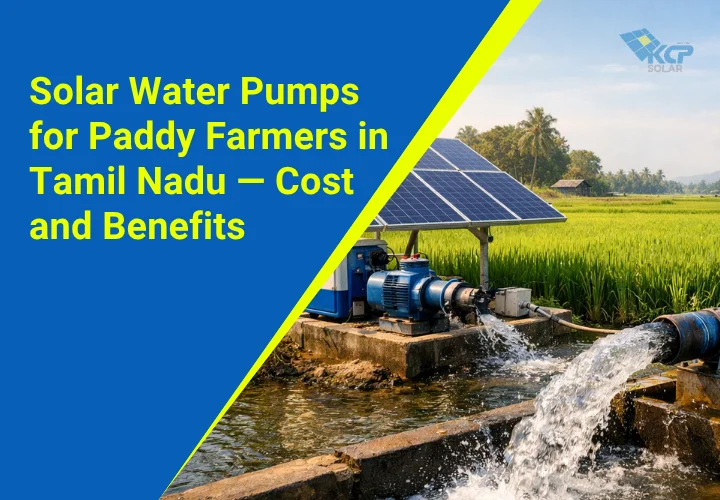
A solar water pump is an irrigation system that uses solar power to pump water from sources such as wells, ponds, rivers, or borewells. The pump is powered by solar panels that convert sunlight into electrical power, rather than by electricity or diesel.
This system is usually composed of a pump controller, motor and solar panels. When the sun is shining, it drives the pump, allowing farmers to irrigate their fields all day. This is why the system of solar-powered irrigation pumps is useful, especially in regions where power is frequently cut or access to electricity is limited.
Why Solar Pumps Are Being Favoured by Paddy Farmers in Tamil Nadu?
Agriculture in Tamil Nadu relies on irrigation a lot, particularly for water-intensive crops such as paddy. Most farmers are turning to the use of solar pumps as an alternative for the long term to make agriculture more sustainable.
Here are the major reasons why this transition is taking place:
- Regular power outages disrupt the irrigation schedule, ultimately affecting crop health.
- Traditional pumps operate on diesel, which greatly increases operating costs.
- Farmers are becoming increasingly aware of environmentally friendly practices.
- Government subsidies and schemes make solar irrigation pumps more affordable.
Benefits of Solar Water Pumps for Paddy Farmers
Replacing the usual pump with a solar pump for agriculture in Tamil Nadu provides benefits that directly increase farm productivity and profitability.
The key advantages to paddy farmers are listed below:
- Less operational expenses: Solar irrigation pumps do not need fuel and also require minimal maintenance once installed.
- Consistent irrigation: Farmers can irrigate fields throughout the day without relying on grid electricity.
- Green alternative: Solar pumps minimise carbon footprint and help increase sustainability in agriculture.
- Long-term savings: It may cost more up front, but it yields significant savings in the long run.
- Less maintenance: The systems have fewer moving parts, thus decreasing the wear and tear.
- Increased crop production: A stable water supply leads to healthier crops and higher yields.
Cost and Government Subsidy in Tamil Nadu
The Tamil Nadu government, along with central schemes, offers substantial subsidies to farmers to help them switch to solar-powered irrigation systems.
The schemes available to farmers offer:
- Subsidy coverage of 60-80 per cent of installation costs.
- Assistance to both small-scale and large-scale farmers.
- Helping with the agricultural departments and renewable energy agencies.
How to Choose the Right Solar Pump
It is important to choose the right solar water pump in order to ensure the required performance and efficiency.
Before making a decision, farmers should take the following factors into account:
- The kind of pump used is determined by whether the water is sourced from a shallow well, a deep borewell or a surface water body.
- Smaller fields may require a higher-capacity solar irrigation pump. Paddy crops need a constant supply of water, and therefore, capacity planning is very important.
- Good-quality panels have higher efficiency even under low-sunlight conditions.
- Select suppliers that provide installation, maintenance and service support.
The Future of Solar Irrigation in Tamil Nadu
The developments in solar technology, along with digital monitoring systems, are making solar irrigation pumps more efficient and accessible. Renewable energy policies are also encouraging farmers to shift away from traditional irrigation practices.
Solar pumps for agriculture in Tamil Nadu will likely lead to improved productivity, reduced environmental impact, and better resource management as more farmers adopt them.
Conclusion
Investing in solar-powered water pumps helps farmers address electricity shortages, high fuel costs, and unreliable irrigation. These eco-friendly systems provide a viable, sustainable, and affordable option that helps ensure agricultural success in the long run.
