
How to Charge Your Electric Vehicle Using Rooftop Solar : The Complete 2026 Guide
Introduction
Harnessing the sun’s energy to power your vehicle is becoming the smarter, greener, and more cost-effective option for many homeowners. Using solar power to charge your vehicle not only eliminates the need for fossil fuel but also promotes a cost-effective way of transportation. This blog walks you through everything you need to know about rooftop solar EV charging to achieve a clean, reliable, and intelligent way to charge your vehicle.
What Is Rooftop Solar EV Charging?
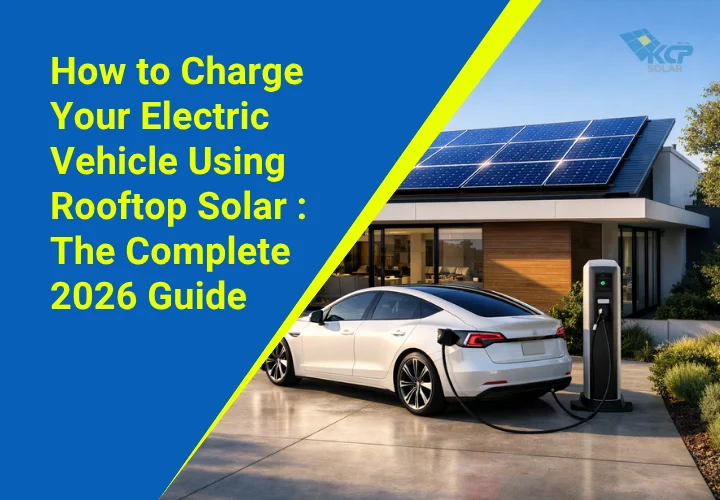
The process through which the rooftop solar panels are used to generate electricity, which is then converted to charge electric vehicles, is referred to as rooftop solar EV charging. This sustainable way of generating electricity lowers operational costs and helps in reducing carbon footprint.
How Does Solar Charging Work for Electric Vehicles?
Here are the steps that homeowners can follow to charge their electric vehicles through rooftop solar panels:
- The EPC contractor installs the rooftop solar panels for EV charging.
- The solar rays hit the panel, generating direct electricity.
- The inverter connected with the panel converts the direct current (DC) into alternating current (AC).
- This alternating current can then be used to charge your vehicle or run your household appliances.
How Many Solar Panels Are Needed to Charge an EV?
Assuming a panel wattage of 400 W, a typical EV needs 6 to 12 solar panels to be fully charged. However, this is just an approximate estimation, and the number of solar panels required depends on a number of factors like:
- Commuting distance
- Solar EV Charging Efficiency
- Solar power availability
- System sizing
In addition, this can be analysed more easily by calculating how many kWh of power is produced by a single panel. Homeowners can do this by calculating:
Hours of daylight per day x wattage = Watt-hours per day
Next, divide it by 1000 to get the kWh of a solar panel per day.
Benefits of Charging Your EV with Rooftop Solar
Charging your EV with solar needs minimal upkeep and is a hassle-free solution. When paired with an energy storage system, a solar charger can keep your EV ready to go even during power shortages.
Apart from significant cost savings and sustainability, using solar panels for EV Charging has numerous benefits:
- EV charging with solar reduces monthly EV charging expenses. Solar charging is much less expensive than public charging stations or relying solely on grid power.
- Saves homeowners from volatility and rising electricity costs.
- Homes equipped with EV charging infrastructure achieve higher property value and ROI than ordinary homes.
- Homeowners can avail various government subsidies, tax credits, and rebates for installing solar systems and purchasing EVs.
Furthermore, integrating Solar EV Charging systems with advanced technologies can make your smart home energy efficient and ecologically stable.
Future Trends in Solar EV Charging
As we navigate towards a cleaner and more sustainable future, staying informed about the latest developments in these fields is essential.
Future trends in solar EV charging include improved energy storage systems, smarter grid integration, and more affordable solar panel options.
By 2030, the solar industry targets to achieve AI-enabled rooftop panels that can automatically optimise charging to maximise solar usage.
The industry is focusing on large-scale solar microgrids with ground-mounted panels to facilitate multiple and fast charging. Scientists are also working on ultra-fast EV charging models that can charge up to 80% in 15–20 minutes, reducing long-distance travel stress.
Apart from these, some other future trends are listed:
- High-efficiency solar cells
- Compact solar charging installation for maximum output
- App integration to provide real-time data and user friendly experience/interface
At KCP Solar, we provide the latest EV solar charging installation to maximise energy output and efficiency. As electric mobility experiences unprecedented growth, our solar team promises EV charging technology that is cleaner and cheaper. Our charging installations offer greater flexibility, resilience, and sustainability to our energy and transportation systems.
Conclusion
As the demand for electric vehicles surges, the demand for convenient and eco-friendly charging options is also on the rise. One such reliable charging solution is through rooftop solar. From lowering costs to reducing environmental impact, the greener way of charging your EV is here. Ensure efficient and customised solar panels for EV charging with KCP Solar and embrace the future of sustainable transportation.
