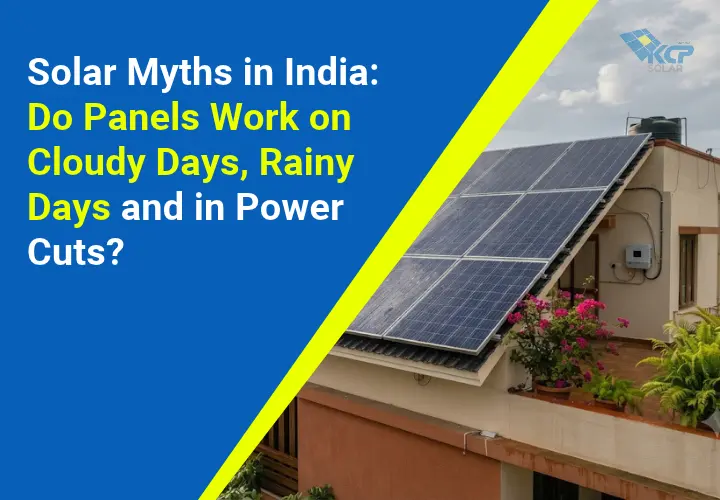
Rooftop solar is growing fast across India, helped by rising electricity bills and schemes like the PM Surya Ghar Muft Bijli Yojana. Yet many families still hesitate because of doubts they have heard from neighbours, relatives or social media. "Panels stop working when it rains." "Solar is useless in cloudy weather." "At least I'll have light during a power cut."
Some of these beliefs are partly true, some are completely wrong, and some are dangerous misunderstandings. In this guide, we separate fact from fiction so you can decide with confidence.
Solar panels run on daylight, not on direct heat or a clear blue sky. Even when clouds block the sun, a good amount of diffused light still reaches the panels. Depending on cloud thickness, panels typically produce roughly 10% to 50% of their normal output.
Thin or scattered clouds reduce generation only slightly. Heavy, dark clouds reduce it much more. The important point is that generation never drops to zero during the day.
India also has a big advantage: most regions receive 250 to 300 sunny days a year. Your panels make up for gloomy days by producing more on bright ones. Solar systems are sized on annual generation, not on a single day's weather, so an occasional cloudy spell rarely hurts your savings in a meaningful way.
Solar panels are built to be weatherproof. Quality panels are sealed, tested for water, hail and high wind, and designed to last 25 years or more outdoors. Heavy monsoon rain is not a threat to them.
In fact, rain is a free cleaning service. Dust, bird droppings and pollution build up on panels, especially in cities like Delhi, Chennai or Hyderabad, and this dirt reduces efficiency. A good shower washes much of it away.
That said, generation does fall during the monsoon because of thick clouds and shorter bright hours. Expect lower output in July and August, but healthy output in the months around them. Over the full year, the average still works out well for most households.
There are three main types of solar systems:
So if your area faces frequent outages and you want uninterrupted power, ask your installer specifically about a hybrid or battery-backed setup. Don't assume a standard rooftop system will keep your lights on.
Going solar in Salem is easier when you follow a clear order:
Usually between 10% and 50% of their rated output, depending on cloud thickness.
No. Quality panels are designed to withstand heavy rain, wind and hail.
No. It shuts down automatically for safety. You need a battery or hybrid system for backup.
Most panels last 25 years or more, though output slowly declines over time.
Solar energy in India is far more reliable than the popular myths suggest. Panels do work on cloudy days, though with reduced output. They handle the rain without trouble, and the monsoon even keeps them clean. The one myth with real substance is about power cuts: a standard on-grid system will go off when the grid does, so choose a hybrid or battery option if backup matters to you.
Cost is easier to manage than most people expect. The central subsidy under the PM Surya Ghar scheme can go up to ₹78,000, and many households recover their investment within four to six years, after which electricity is nearly free.
The best way to decide is to talk to two or three trusted installers, check your roof's sunlight exposure, and compare your current bills with the expected savings. With the right system, solar can cut your electricity costs for decades and help India move toward cleaner energy.
Ready to explore solar for your home? Request a free site assessment and a clear savings estimate today.


Connect with us