
October 6, 2026
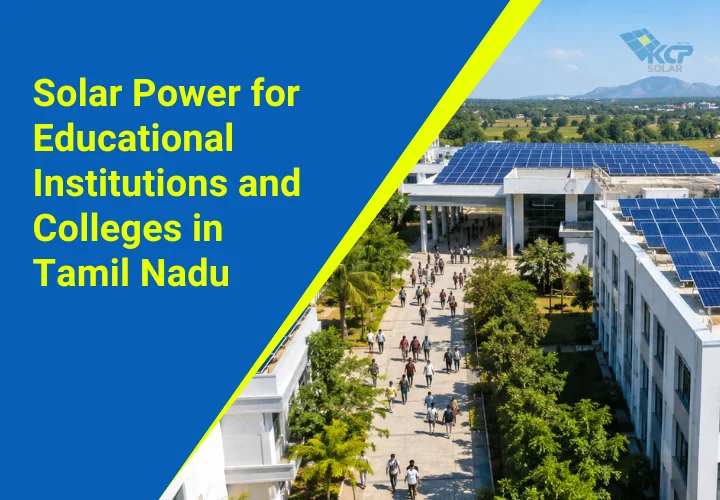
Solar Power for Educational Institutions and Colleges in Tamil Nadu
May 08, 2026
Introduction
Going solar is the need of the hour. On top of that, proper installation Solar energy is one of the best and most enduring solutions to India's growing energy demands. In Tamil Nadu, colleges and educational institutions are turning to solar power as an alternative to traditional electricity.
As more infrastructure, digital classes, and residential units are being built, institutions are experiencing an increase in power consumption, making rooftop solar for educational institutions an efficient and future-oriented solution.
This blog examines the transformations that solar energy is bringing to learning institutions, its advantages, cost factors and the future.
Understanding Solar Power in Educational Institutions
Universities and colleges are the best places to adopt solar power because their rooftop areas are large and they are used most of the day. Rooftop solar for educational institutions operates by converting sunlight into electricity using photovoltaic panels mounted on buildings.
A standard solar system comprises solar panels, inverters, mounting frames and optional battery storage. The resulting electricity can be consumed on campus, reducing dependence on grid power. This makes solar power for colleges very efficient and cost-effective in the long run.
Key Benefits of Solar Power for Colleges
The significant benefits of adopting solar power for colleges in Tamil Nadu are as follows:
Reduced Electricity Costs
Colleges use a lot of electricity daily. By installing rooftop solar for educational institutions, campuses can significantly reduce their electricity bills. The savings are recovered over time, covering the cost of installation of the solar panels.
Environmentally Friendly
Solar energy is clean and renewable. With the college installing solar, the institution can decrease its carbon footprint and enhance sustainability among students and employees.
Reliable Power Supply
Frequent power cuts can interrupt classes, whereas a solar system combined with backup systems provides a reliable, continuous source of energy, and operations do not stop even in cases of grid failure.
Low Maintenance Requirements
Modern solar systems are long-lasting and require little maintenance. Routine cleaning and regular inspection are typically sufficient to maintain performance, making rooftop solar a hassle-free investment for educational institutions.
Enhanced Learning Opportunities
Solar facilities can be used as learning resources for students, particularly in engineering and environmental studies, to motivate innovation and consciousness on renewable energy.
Cost & Implementation of Solar Systems
The cost of solar panel installation is usually the main concern for institutions. The total price is based on:
- System capacity and energy needs.
- Kind and performance of solar panels.
- Complexity of installation and roof design.
- Inclusion of battery storage systems
Rooftop solar for educational institutions is cheaper in Tamil Nadu, which has supportive policies including net metering and subsidies. The institutions can also sell surplus electricity to the grid, further increasing returns.
The implementation process generally involves energy assessment, system design, installation and continuous monitoring. Most colleges recoup the solar panel installation cost in a few years despite the initial expense.
Future of Solar in Educational Institutions
Solar power in colleges in Tamil Nadu has a bright future. As awareness of solar energy grows, policy support and technological advancements are driving more institutions to switch to solar energy.
Rooftop solar in educational institutions is becoming more reliable and cost-effective through innovations such as smart monitoring systems, improved battery storage, and high-efficiency panels. With sustainability the order of the day, the use of solar power will become the norm on campuses.
We are a solar EPC provider offering end-to-end solutions for educational institutions. Our services include:
- Customised solar power for colleges based on campus energy needs
- Scalable and efficient rooftop solar in schools.
- Higher quality elements with long-term performance.
- Assistance in design, installation, panel maintenance and monitoring.
We aim to assist institutions in moving to using solar energy with maximum savings and efficiency.
Conclusion
The adoption of solar power is changing how colleges meet their energy requirements in Tamil Nadu. Solar energy is a wise choice in the future because of its advantages, including low electricity bills, sustainability, and a reliable power supply.
The cost of installing solar panels needs to be planned, but the benefits are long-term, and the cost is negligible. With the implementation of rooftop solar at educational institutions, colleges can be on the frontline in embracing clean energy and creating a sustainable future.
Latest Post


Solar Panel Price in India: What It Costs and How...
October 6, 2026

Solar Company in India: The Complete 2026 Guide
September 9, 2026