October 6, 2026
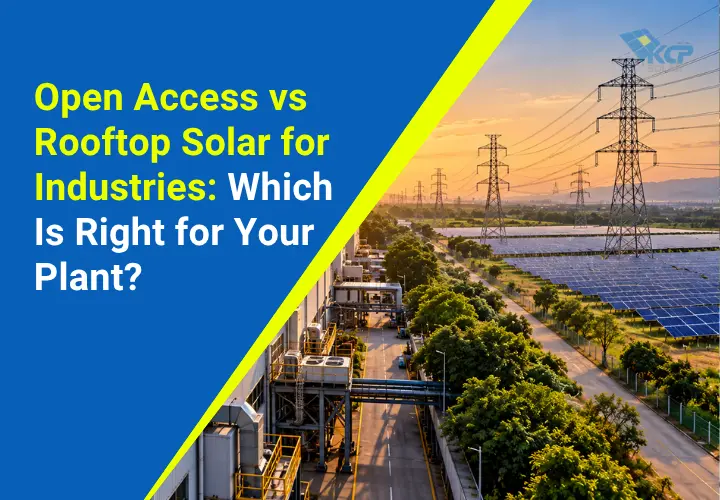
Open Access vs Rooftop Solar for Industries: Which Is Right for Your Plant?
October 06, 2026
Introduction
Electricity is one of the biggest running costs for any factory, and solar is one of the most reliable ways to reduce it. But industries can go solar in two very different ways. You can install panels on your own roof, or buy power from a solar plant located elsewhere and have it delivered through the grid, known as open access. Each route has different costs, limits, and risks. This guide explains both so you can pick the one that fits your plant.
What Is Rooftop Solar for Industries?
Rooftop solar is installed on your roof, shed or parking area, behind your own electricity meter. Your plant uses the power on site first, so you pay no charges for using the grid network. You can own the system outright (CAPEX) or pay a developer for each unit of power (OPEX).
Its main limit is space. As a rough guide, you need 8–10 sq m of shadow-free area per kW, so a 1 MW system needs about 8,000–10,000 sq m. Roof strength, shading, and roof type also matter.
What Is Open Access Solar?
With open access, a solar plant at another location generates power, and the state grid carries it to your factory. You pay regulated charges for using the network, which may include transmission, wheeling, cross-subsidy and additional surcharges, and banking or scheduling fees.
You can buy from a third-party plant, or join a group captive arrangement, where several consumers hold equity in the plant. Each state regulator sets eligibility thresholds and charges, so they differ widely from state to state.
Rooftop vs Open Access at a Glance
Rooftop solar is built on your own premises, so it has no grid charges, needs only grid connection approval, and carries low regulatory risk. It works best when your daytime load can be matched to your roof space.
Open access uses an off-site plant, so you pay wheeling, transmission, surcharges and banking charges. It needs open access approvals and scheduling, and it is exposed to changes in tariff orders. It works best when your demand is far larger than your roof can supply.
The Cost Question
Rooftop cost is simple: equipment and installation, with no grid charges. Open access cost is the generation cost plus a stack of regulated charges, and that stack can change whenever the regulator issues a new tariff order.
Because charges vary by state and voltage level, don't rely on a single figure from an article. Ask any provider for a landed-cost calculation based on your state's latest order, then compare it with your current industrial tariff.
When Rooftop Is the Better Choice
- You have a large, strong, unshaded roof or spare land.
- Your daytime load is moderate and the roof can cover a good share of it.
- You want a faster installation with less regulatory work.
- You prefer not to depend on future changes in grid charges.
When Open Access Is the Better Choice
- Your power demand is far larger than your roof can generate.
- Your contract demand meets your state's eligibility threshold.
- You can manage scheduling, approvals and banking rules.
- You are comfortable with a long-term power supply agreement.
Can You Use Both?
Yes. Many factories maximise rooftop first, since it avoids all grid charges, then cover the remaining load with open access. Ground-mounted structures and solar carports can add capacity inside your premises before you look off-site. That also reduces your exposure to regulatory changes.
Five Questions to Help You Decide
- How much usable roof and land area do you have?
- What share of your load runs in daytime hours?
- What is your contract demand, and do you qualify for open access?
- What is the landed cost of open access power compared with your current tariff?
- Can your team handle approvals, scheduling and compliance over the long term?
Frequently Asked Questions
01 Is open access always cheaper than rooftop solar?
No. Grid charges can reduce or remove the savings, depending on your state, voltage level and the current tariff order.
02 Does rooftop solar need grid approval?
Yes. You need grid connection permission from the distribution company before commissioning.
03 How long does installation take?
Rooftop projects typically take weeks to a few months depending on size. Open access takes longer because of approvals and agreements.
04 Can a small factory use open access?
Only if its contract demand meets the state’s eligibility limit. Smaller plants usually start with rooftop solar.
Conclusion
Rooftop solar is simpler, carries no grid charges and works well when your roof and land can cover a good share of your daytime load. Open access suits factories whose demand is much larger than their available space, but it brings approvals, ongoing compliance and exposure to tariff changes. For many industries, the best plan is to install as much rooftop or ground-mounted solar as the site allows, then look at open access for the rest.
KCP Solar designs rooftop, ground-mounted and carport solar for factories. Share your electricity bill and roof area, and we'll estimate how much of your load solar can cover.
Latest Post
Solar Panel Price in India: What It Costs and How...
October 6, 2026
Solar Company in India: The Complete 2026 Guide
September 9, 2026